In mathematics a topological space is called countably compact if every countable open cover has a finite subcover.
Equivalent definitions
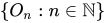
A topological space X is called countably compact if it satisfies any of the following equivalent conditions: [1][2]
- (1) Every countable open cover of X has a finite subcover.
- (2) Every infinite set A in X has an ω-accumulation point in X.
- (3) Every sequence in X has an accumulation point in X.
- (4) Every countable family of closed subsets of X with an empty intersection has a finite subfamily with an empty intersection.
Proof of equivalence |
|---|
|
(1) (2): Suppose (1) holds and A is an infinite subset of X without -accumulation point. By taking a subset of A if necessary, we can assume that A is countable. Every has an open neighbourhood such that is finite (possibly empty), since x is not an ω-accumulation point. For every finite subset F of A define . Every is a subset of one of the , so the cover X. Since there are countably many of them, the form a countable open cover of X. But every intersect A in a finite subset (namely F), so finitely many of them cannot cover A, let alone X. This contradiction proves (2). (2) (3): Suppose (2) holds, and let be a sequence in X. If the sequence has a value x that occurs infinitely many times, that value is an accumulation point of the sequence. Otherwise, every value in the sequence occurs only finitely many times and the set is infinite and so has an ω-accumulation point x. That x is then an accumulation point of the sequence, as is easily checked. (3) (1): Suppose (3) holds and is a countable open cover without a finite subcover. Then for each we can choose a point that is not in . The sequence has an accumulation point x and that x is in some . But then is a neighborhood of x that does not contain any of the with , so x is not an accumulation point of the sequence after all. This contradiction proves (1). (4) (1): Conditions (1) and (4) are easily seen to be equivalent by taking complements. |








Examples
- The first uncountable ordinal (with the order topology) is an example of a countably compact space that is not compact.[3]
Properties
- Every compact space is countably compact.
- A countably compact space is compact if and only if it is Lindelöf.
- Every countably compact space is limit point compact.
- For T1 spaces, countable compactness and limit point compactness are equivalent.
- Every sequentially compact space is countably compact.[4] The converse does not hold. For example, the product of continuum-many closed intervals with the product topology is compact and hence countably compact; but it is not sequentially compact.[5]
- For first-countable spaces, countable compactness and sequential compactness are equivalent.[6] More generally, the same holds for sequential spaces.[7]
- For metrizable spaces, countable compactness, sequential compactness, limit point compactness and compactness are all equivalent. The same holds for second countable Hausdorff spaces.
- The example of the set of all real numbers with the standard topology shows that neither local compactness nor σ-compactness nor paracompactness imply countable compactness.
- Closed subspaces of a countably compact space are countably compact.[8]
- The continuous image of a countably compact space is countably compact.[9]
- Every countably compact space is pseudocompact.
- In a countably compact space, every locally finite family of nonempty subsets is finite.[10][11]
- Every countably compact paracompact space is compact.[12][11] More generally, every countably compact metacompact space is compact.[13]
- Every countably compact Hausdorff first-countable space is regular.[14][15]
- Every normal countably compact space is collectionwise normal.
- The product of a compact space and a countably compact space is countably compact.[16][17]
- The product of two countably compact spaces need not be countably compact.[18]
![{\displaystyle [0,1]}](https://wikimedia.org/api/rest_v1/media/math/render/svg/738f7d23bb2d9642bab520020873cccbef49768d)
See also
Notes
- ↑ Steen & Seebach, p. 19
- ↑ "General topology - Does sequential compactness imply countable compactness?".
- ↑ Steen & Seebach 1995, example 42, p. 68.
- ↑ Steen & Seebach, p. 20
- ↑ Steen & Seebach, Example 105, p, 125
- ↑ Willard, problem 17G, p. 125
- ↑ Kremsater, Terry Philip (1972), Sequential space methods (Thesis), University of British Columbia, doi:10.14288/1.0080490, Theorem 1.20
- ↑ Willard, problem 17F, p. 125
- ↑ Willard, problem 17F, p. 125
- ↑ Engelking 1989, Theorem 3.10.3(ii).
- 1 2 "Countably compact paracompact space is compact".
- ↑ Engelking 1989, Theorem 5.1.20.
- ↑ Engelking 1989, Theorem 5.3.2.
- ↑ Steen & Seebach, Figure 7, p. 25
- ↑ "Prove that a countably compact, first countable T2 space is regular".
- ↑ Willard, problem 17F, p. 125
- ↑ "Is the Product of a Compact Space and a Countably Compact Space Countably Compact?".
- ↑ Engelking, example 3.10.19
References
- Engelking, Ryszard (1989). General Topology. Heldermann Verlag, Berlin. ISBN 3-88538-006-4.
- James Munkres (1999). Topology (2nd ed.). Prentice Hall. ISBN 0-13-181629-2.
- Steen, Lynn Arthur; Seebach, J. Arthur Jr. (1995) [1978]. Counterexamples in Topology (Dover reprint of 1978 ed.). Berlin, New York: Springer-Verlag. ISBN 978-0-486-68735-3.
- Willard, Stephen (2004) [1970], General Topology (Dover reprint of 1970 ed.), Addison-Wesley