| A joint Politics and Economics series |
| Social choice and electoral systems |
|---|
 |
 Mathematics portal Mathematics portal |


Maximal lotteries are a probabilistic voting rule that use ranked ballots and returns a lottery over candidates that a majority of voters will prefer, on average, to any other.[1] In other words, in a series of repeated head-to-head matchups, voters will (on average) prefer the results of a maximal lottery to the results produced by any other voting rule.
Maximal lotteries satisfy a wide range of desirable properties: they elect the Condorcet winner with probability 1 if it exists[1] and never elect candidates outside the Smith set.[1] Moreover, they satisfy reinforcement,[2] participation,[3] and independence of clones.[2] The probabilistic voting rule that returns all maximal lotteries is the only rule satisfying reinforcement, Condorcet-consistency, and independence of clones.[2] The social welfare function that top-ranks maximal lotteries has been uniquely characterized using Arrow's independence of irrelevant alternatives and Pareto efficiency.[4]
Maximal lotteries do not satisfy the standard notion of strategyproofness, as Allan Gibbard has shown that only random dictatorships can satisfy strategyproofness and ex post efficiency.[5] Maximal lotteries are also nonmonotonic in probabilities, i.e. it is possible that the probability of an alternative decreases when a voter ranks this alternative up.[1] However, they satisfy relative monotonicity, i.e., the probability of relative to that of does not decrease when is improved over .[6]


The support of maximal lotteries, which is known as the essential set or the bipartisan set, has been studied in detail.[7][8][9][10]
History
Maximal lotteries were first proposed by the French mathematician and social scientist Germain Kreweras in 1965[11] and popularized by Peter Fishburn.[1] Since then, they have been rediscovered multiple times by economists,[8] mathematicians,[1][12] political scientists, philosophers,[13] and computer scientists.[14]
Several natural dynamics that converge to maximal lotteries have been observed in biology, physics, chemistry, and machine learning.[15][16][17]
Collective preferences over lotteries
The input to this voting system consists of the agents' ordinal preferences over outcomes (not lotteries over alternatives), but a relation on the set of lotteries can be constructed in the following way: if and are lotteries over alternatives, if the expected value of the margin of victory of an outcome selected with distribution in a head-to-head vote against an outcome selected with distribution is positive. In other words, if it is more likely that a randomly selected voter will prefer the alternatives sampled from to the alternative sampled from than vice versa.[4] While this relation is not necessarily transitive, it does always admit at least one maximal element.


It is possible that several such maximal lotteries exist, as a result of ties. However, the maximal lottery is unique whenever the number of voters is odd.[18] By the same argument, the bipartisan set is uniquely defined by taking the support of the unique maximal lottery that solves a tournament game.[8]
Strategic interpretation
Maximal lotteries are equivalent to mixed maximin strategies (or Nash equilibria) of the symmetric zero-sum game given by the pairwise majority margins. As such, they have a natural interpretation in terms of electoral competition between two political parties[19] and can be computed in polynomial time via linear programming.
Example
Suppose there are five voters who have the following preferences over three alternatives:
- 2 voters:
- 2 voters:
- 1 voter:


The pairwise preferences of the voters can be represented in the following skew-symmetric matrix, where the entry for row and column denotes the number of voters who prefer to minus the number of voters who prefer to .
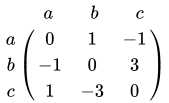
This matrix can be interpreted as a zero-sum game and admits a unique Nash equilibrium (or minimax strategy) where , , . By definition, this is also the unique maximal lottery of the preference profile above. The example was carefully chosen not to have a Condorcet winner. Many preference profiles admit a Condorcet winner, in which case the unique maximal lottery will assign probability 1 to the Condorcet winner. If the last voter in the example above swaps alternatives and in his preference relation, becomes the Condorcet winner and will be selected with probability 1.


References
- 1 2 3 4 5 6 Fishburn, P. C. (1984). "Probabilistic Social Choice Based on Simple Voting Comparisons". The Review of Economic Studies. 51 (4): 683–692. doi:10.2307/2297786. ISSN 0034-6527.
- 1 2 3 F. Brandl, F. Brandt, and H. G. Seedig. Consistent probabilistic social choice. Econometrica. 84(5), pages 1839-1880, 2016.
- ↑ F. Brandl, F. Brandt, and J. Hofbauer. Welfare Maximization Entices Participation. Games and Economic Behavior. 14, pages 308-314, 2019.
- 1 2 F. Brandl and F. Brandt. Arrovian Aggregation of Convex Preferences. Econometrica. 88(2), pages 799-844, 2020.
- ↑ Gibbard, Allan (1977). "Manipulation of Schemes that Mix Voting with Chance". Econometrica. 45 (3): 665–681. doi:10.2307/1911681. hdl:10419/220534. ISSN 0012-9682. JSTOR 1911681.
- ↑ Brandl, Florian; Brandt, Felix; Stricker, Christian (2022-01-01). "An analytical and experimental comparison of maximal lottery schemes". Social Choice and Welfare. 58 (1): 5–38. doi:10.1007/s00355-021-01326-x. hdl:10419/286729. ISSN 1432-217X.
- ↑ B. Dutta and J.-F. Laslier. Comparison functions and choice correspondences. Social Choice and Welfare, 16: 513–532, 1999.
- 1 2 3 G. Laffond, J.-F. Laslier, and M. Le Breton. The bipartisan set of a tournament game. Games and Economic Behavior, 5(1):182–201, 1993.
- ↑ Laslier, J.-F. Tournament solutions and majority voting Springer-Verlag, 1997.
- ↑ Brandt, Felix; Brill, Markus; Seedig, Hans Georg; Suksompong, Warut (2018-03-01). "On the structure of stable tournament solutions". Economic Theory. 65 (2): 483–507. doi:10.1007/s00199-016-1024-x. ISSN 0938-2259.
- ↑ G. Kreweras. Aggregation of preference orderings. In Mathematics and Social Sciences I: Proceedings of the seminars of Menthon-Saint-Bernard, France (1–27 July 1960) and of Gösing, Austria (3–27 July 1962), pages 73–79, 1965.
- ↑ Fisher, David C.; Ryan, Jennifer (1995). "Tournament games and positive tournaments". Journal of Graph Theory. 19 (2): 217–236. doi:10.1002/jgt.3190190208. ISSN 1097-0118.
- ↑ Felsenthal, Dan S.; Machover, Moshé (1992). "After two centuries, should condorcet's voting procedure be implemented?". Behavioral Science. 37 (4): 250–274. doi:10.1002/bs.3830370403. ISSN 1099-1743.
- ↑ R. L. Rivest and E. Shen. An optimal single-winner preferential voting system based on game theory. In Proceedings of 3rd International Workshop on Computational Social Choice, pages 399–410, 2010.
- ↑ Laslier, Benoît; Laslier, Jean-François (2017-10-01). "Reinforcement learning from comparisons: Three alternatives are enough, two are not". The Annals of Applied Probability. 27 (5): 2907–2925. doi:10.1214/16-AAP1271. ISSN 1050-5164.
- ↑ Grilli, Jacopo; Barabás, György; Michalska-Smith, Matthew J.; Allesina, Stefano (2017-08-01). "Higher-order interactions stabilize dynamics in competitive network models". Nature. 548 (7666): 210–213. doi:10.1038/nature23273. ISSN 1476-4687.
- ↑ F. Brandl and F. Brandt. A Natural Adaptive Process for Collective Decision-Making. Theoretical Economics 19(2): 667–703, 2024.
- ↑ Laffond, Gilbert; Laslier, Jean-Francois; Le Breton, Michel (1997-02-01). "A Theorem on Symmetric Two-Player Zero-Sum Games". Journal of Economic Theory. 72 (2): 426–431. doi:10.1006/jeth.1996.2215. ISSN 0022-0531.
- ↑ Laslier, J.-F. Interpretation of electoral mixed strategies. Social Choice and Welfare 17: pages 283–292, 2000.
External links
- voting.ml (website for computing maximal lotteries)